

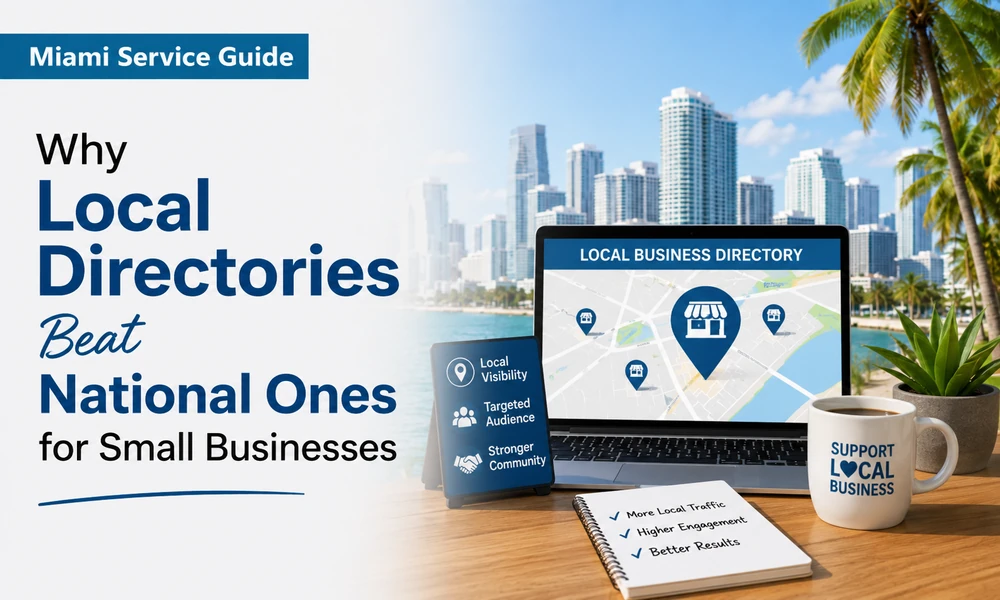
When small business owners think about getting listed online, the big national directories often come to mind first-massive platforms with millions of users and household-name recognition. But bigger isn’t always better. For small, community-rooted businesses, local directories such as MiamiServiceGuide.com, which caters to South Florida, frequently deliver more value, more relevant traffic, and a better return on the time invested than their national counterparts.
Relevance Over Reach
National directories are built for scale, which means they’re designed to serve everyone, everywhere. That broad reach comes at a cost: relevance. A small bakery or independent auto repair shop gets buried among thousands of similar listings from cities the owner has never even heard of. Local directories, by contrast, are curated around a specific community. Every listing is inherently relevant to someone searching nearby, which means the traffic a local directory sends is pre-qualified-people who are actually in a position to walk through the door.
Stronger Local SEO Signals
Search engines increasingly reward businesses that show up consistently across sources tied to their actual location. A listing on a respected local directory reinforces exactly the kind of geographic and community relevance that search algorithms look for. National directories can help too, but they often lack the neighborhood-level specificity that helps a business rank for searches like “family dentist in [neighborhood]” rather than just “dentist.” Local directories give small businesses an edge precisely where it counts: in local search results, on maps, and in voice search queries tied to a specific area.
Less Competition, More Visibility
On a national platform, a small business is competing against thousands of listings, including large chains with bigger marketing budgets and dedicated teams managing their online presence. On a local directory, that same business might be one of a few dozen in its category. This dramatically increases the odds of being seen, clicked, and chosen. Small businesses don’t need to out-market a national brand-they just need to be the obvious, easy choice within their own community, and local directories are built to make that happen.
Community Trust and Context
Local directories often come with community context that national platforms simply can’t replicate: neighborhood guides, local event tie-ins, and curation by people who actually know the area. Customers browsing a local directory tend to trust that the businesses listed have some connection to, or vetting by, the local community. That built-in credibility helps a small business feel like a known quantity rather than one more anonymous listing in an ocean of national noise.
Lower Cost, Higher Value
Many national directories charge premium rates for prominent placement, banking on the assumption that businesses need national exposure to compete. Local directories are typically more affordable, and sometimes free, because they aren’t competing to serve a global audience. For a small business with a limited marketing budget, that means a lower cost per lead and a more efficient way to spend limited resources.
The Bottom Line
National directories aren’t without value, but for small businesses whose customers are overwhelmingly local, they often deliver diluted results at a premium price. Local directories offer sharper targeting, stronger local SEO benefits, less competitive clutter, and built-in community trust-all at a lower cost. For a small business trying to grow within its own backyard, local is often simply smarter.