

Infrastructure development, industrial construction, and the installation of heavy equipment across manufacturing, energy, and commercial real estate projects generate substantial demand for specialist lifting equipment that most project operators do not maintain in the own fleet. Telescopic crane rental and hydraulic crane rental services provide the lifting capacity and precision that these projects require, without the capital commitment and operational overhead of equipment ownership. Understanding how these crane types differ, what applications each serves, and what to evaluate when engaging crane rental services helps project managers and procurement teams make reliable equipment selection decisions.
What is a telescopic crane?
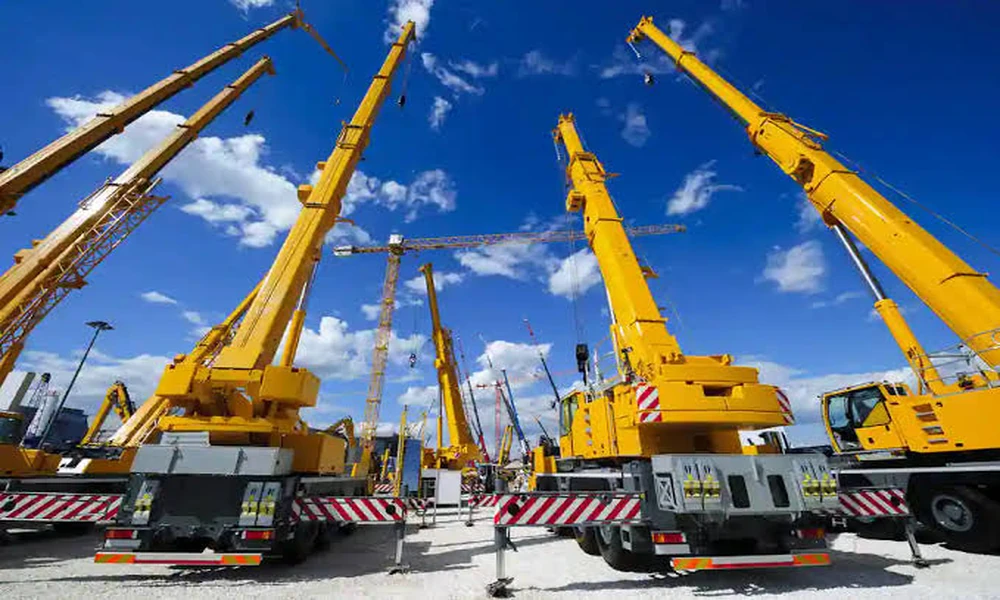
A telescopic crane uses a boom system composed of nested tubular sections that extend and retract hydraulically to achieve the required working radius and height. The telescoping mechanism allows the crane to be transported with the boom retracted to a compact configuration and extended on-site to the working length required for the lift. Telescopic crane rental is the most commonly requested crane category for construction sites, industrial installations, and infrastructure projects because of the configuration flexibility and mobility that the telescopic boom provides.
The key operational characteristics of telescopic cranes that make telescopic crane rental the preferred choice for a wide range of projects:
- Variable reach without jib changes: the telescoping boom allows the operator to adjust working radius and height from the cab without disassembling the boom configuration, which significantly reduces the setup time between lifts and the time cost of adapting to varying lift geometries across a project
- Road mobility: all-terrain telescopic cranes can travel on public roads between sites on the own drive systems, eliminating the transport cost and permit requirements associated with crawler cranes that must be transported on low-loaders
- Quick setup: the compact transport configuration and the hydraulic extension system allow most telescopic cranes to be operational within hours of arriving on site, compared to lattice boom cranes that require multi-day assembly processes
- Outrigger extension for stability: the outrigger system allows the crane’s stability base to be extended for heavy lifts, with the outrigger configuration calculated against the ground bearing capacity and the lift load for each specific operating position
What is hydraulic crane rental?
Hydraulic crane rental covers the broad category of cranes whose lifting and boom extension mechanisms are powered by hydraulic systems, which encompasses both telescopic mobile cranes and hydraulic truck cranes. In common usage, hydraulic crane rental typically refers to truck-mounted hydraulic cranes, also known as pick-and-carry cranes, that can travel with a load suspended from the hook and are particularly useful for in-plant movement of heavy components across manufacturing facilities and process plants.
The applications where hydraulic crane rental from the truck-mounted or pick-and-carry category is most appropriate include:
- In-plant heavy equipment installation where the crane needs to move between multiple pick-up and set-down points within a confined facility layout
- Pipeline and process plant construction where heavy pipe sections or vessels need to be transported short distances within the site as well as lifted into position
- Precast concrete installation where the crane moves along the site as elements are placed sequentially
How is crane capacity specified for a lifting project?
The selection of the correct crane for any lift requires the calculation of the maximum rated capacity at the required operating radius. Crane capacity is not a fixed number but a function of the working radius (horizontal distance from the crane’s centre of rotation to the load), the boom length and angle, and the outrigger or counterweight configuration in use. A crane rated at 100 tonnes has that capacity only at the minimum radius and boom length; the available capacity reduces significantly as the working radius increases.
For online crane service, providing the crane rental company with the load weight, the required hook height, the required working radius, and the available ground bearing capacity at the crane position allows the rental company to confirm that the specified crane is correctly sized for the lift and to calculate the required outrigger configuration.